
The Curriculum Development team of the Madrasah Centre of Excellence (MCE) has recently released the Draft Curriculum Framework for Madrasah which was produced after a lengthy process of consensus and consultation with religious scholars, educationalists and madrasah teachers. A detailed review of the major curricula currently used by madaris globally was also carried out. A copy of the Framework document is being sent to teachers in each Madrasah in every region.

Translate this page

26 October 2026 / 14. Jamaad-Ul-Awwal 1448
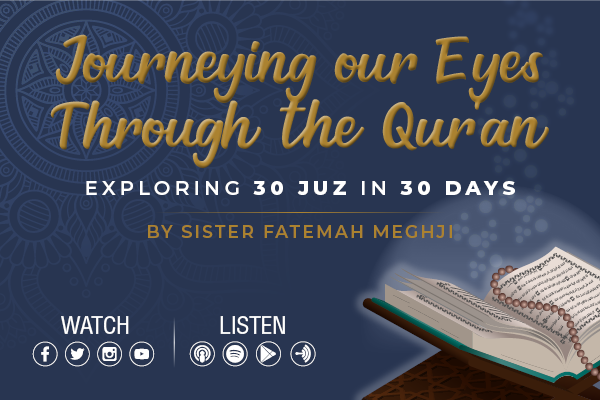
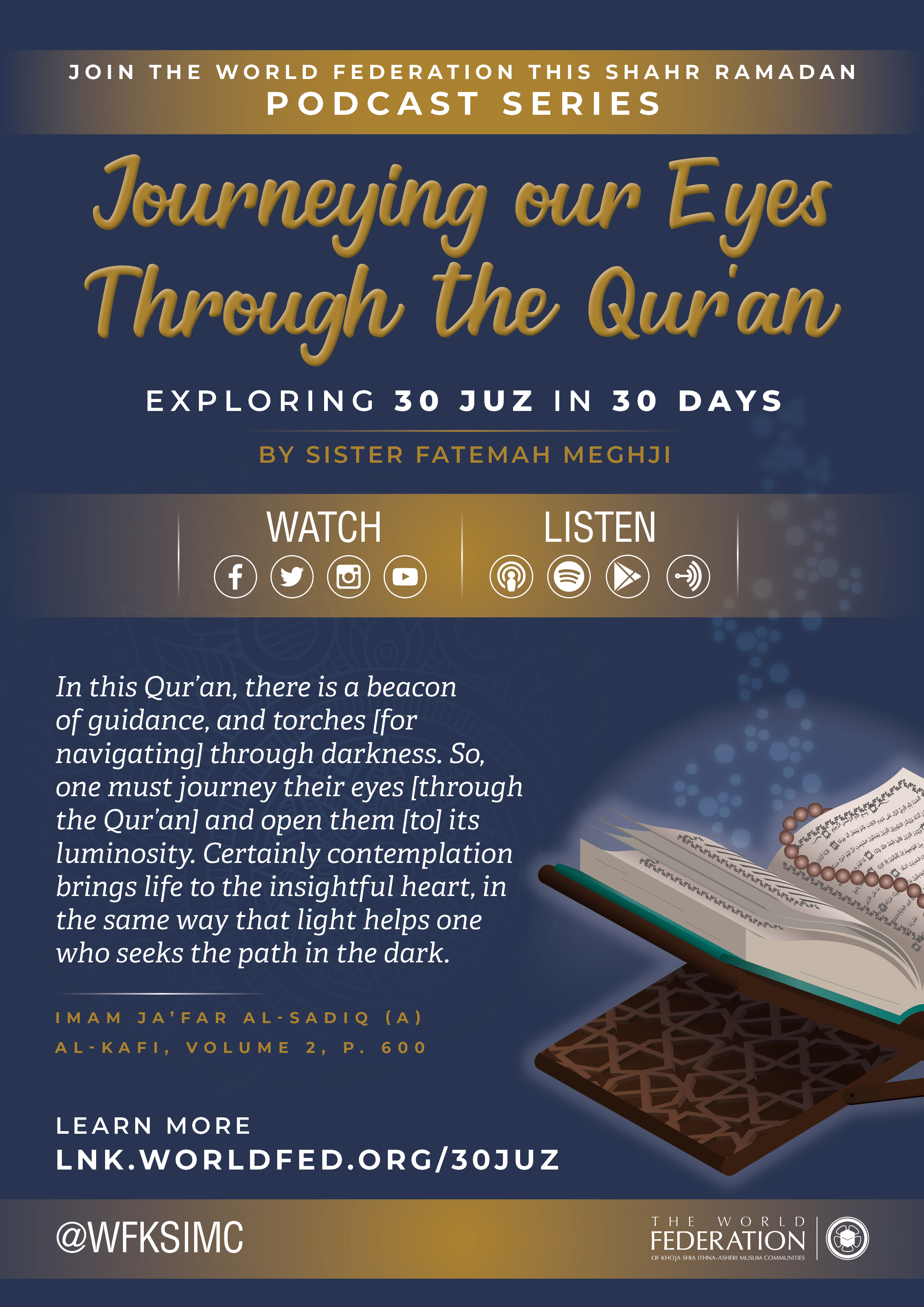
Journeying our eyes through the Quran
It is narrated that Imam Ja’far al-Sadiq (as) has said:
"In this Qur’an, there is a beacon of guidance, and torches [for navigating] through darkness. So, one must journey their eyes [through the Qur’an] and open them [to] its luminosity. Certainly contemplation brings life to the insightful heart, in the same way that light helps one who seeks the path in the dark."
(Reference: Al-Kafi, Volume 2, p. 600)
Taking inspiration from this hadith, for the 30 days of the month of Ramadan, we will journey our eyes through the Qur’an and explore themes from each juz of the Qur’an daily.
The approach of this series is to touch on a set of verses from each juz, and to then explore a specific theme.
The themes explored will include
- ones related to understanding God and His attributes,
- how to attain taqwa,
- understanding some of the beautiful stories and lessons that lie interspersed throughout the Qur’an.
We pray that this series will serve as a meaningful companion to all of you in this blessed month, as it takes you on a small journey throughout all 30 juz.
To make the most of this podcast series, we suggest following the steps below:
- Start by listening to the podcast episode each day, which will explore one theme relevant to the juz of the day.
- Read a juz of the Qur’an daily by reciting it in Arabic (or listening to it).
- Simultaneously read the translation in English.
- Recommended translations include the ones by: MAS Abdel Haleem, Ali Quli Qara’i, Saheeh International, and Talal Itani.
- Take notes, and share!
About the speaker:
Fatemah Meghji is based in her hometown, Vancouver, Canada (on unceded Coast Salish territories). She completed her BA in English Literature and Religious Studies from the University of British Columbia, after which she left to study in Qum. She studied at Jamiat al-Zahra in Qum for five years and completed the MA program in Qur'anic Tafsir and Qur'anic Sciences. She is now an instructor at the Mizan Institute (mizaninstitute.org), Islamic Literacy, and is the founder of www.playPURE.org . Her current projects include a book on human evolution in the Shi'ite tradition, and her research interests include usul al-tafsir, Qur'anic hermeneutics, postmodern ethics, and women in the tradition.
She can be contacted at: [email protected] or instagram.com/fmegs7

Watch or listen to our series on any of the channels below:
Social Media
YouTube: https://www.youtube.com/WorldFederationKSIMC
Facebook: https://www.facebook.com/WFKSIMC/
Instagram: https://www.instagram.com/wfksimc/
Twitter: https://twitter.com/wfksimc
Podcasts:
Anchor: http://lnk.worldfed.org/Anchor
Apple Podcasts: http://lnk.worldfed.org/Apple
Spotify: http://lnk.worldfed.org/Spotify
Google: http://lnk.worldfed.org/Google
Related News
Fatimiyyah – Remembering the Sermon of Sayyida Fatima SA. Watch the three short videos by Dr. Mahjabeen Dhala here.

Updated 4 September 2013
Providing service to the community on Family Ethics is not just the objective of The World Federation India Office but also the Khoja Shia Ithna-Asheri Jamaat Mumbai. Keeping this in mind, both the organisations join hands in presenting 4 Workshops on Family Ethics.