

Apply now for Madinah & Bab summer course 2019! Donate Now

Translate this page

15 October 2026 / 3. Jamaad-Ul-Awwal 1448
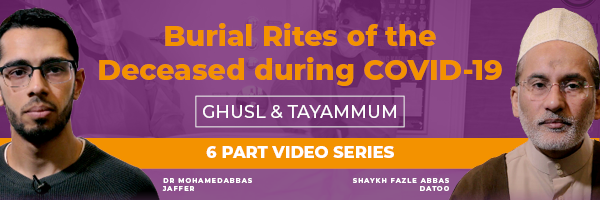
Burial Rites of the Deceased during Covid-19 Ghusl & Tayammum
Losing a loved one is one of the most difficult trials we face in life, even during the best of circumstances. Under the current climate of the Covid-19 pandemic, this trial and ordeal has proved even more challenging.
In Islam, it is obligatory to perform the rites of Ghusl (ritual washing) and kafn (ie the whole process of shrouding with the kafn) upon the mayyit (dead body) before burial. And under specific circumstances that Ghusl cannot be performed Tayammum should be performed.
From the very onset when we saw the emergence of Covid-19, The WF sought guidance from the Office of His Eminence Sayyid al-Sistani (may Allah SWT grant him a long & healthy life) on the new fiqhi rulings to adapt to the emerging challenges.
In an endeavour to continue these efforts, The WF have produced a series of videos to provide guidance and clarity for those in charge of administering the burial rites of the deceased. All the information put together is in accordance to the instructions given by the Marja’s Office.
Videos
Video Part 1: Introduction
Video Part 2: Answers to 7 Very Important Questions
Video Part 3: Personal and PPE Preparation
Video Part 4: Adaptations to the Ghusl Procedure
Video Part 5: Demonstration of Tayammum during Covid-19
Video Part 6: Removing and Discarding the PPE
Related News
Named after the great Prophet Abraham, who championed monotheism, this exhibition echoes the unanimous acclamation of monotheism in the three major faith traditions of Judaism, Christianity and Islam.