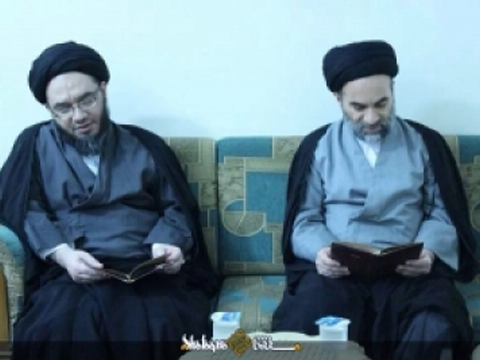
Sayyed Muhamad Raza Sistani (right) & Sayed Muhammad Baqir (left)
In the Name of Allah, the Beneficent, the Most Merciful
"Some of them are descendants of the others, and Allah is all-Hearing, all-Knowing." (3:34)
Two sons of Ayatullah Sistani, Sayyed Muahmmad Raza and Sayyed Muhammad Baqir, deliver advanced level Hawza studies famously known as Bahath al Kahrij (in Iraq) or Dars e Kharij (in Iran) on a daily basis.
During my two day stay in Najaf, I had the opportunity to sit in the fiqh classes of Sayyed Muhammad Raza, which start at 7.15 a.m. and last for 30 minutes. He was teaching the chapter of Tawaf of Hajj with a detailed arguments on its rulings. Everyone was not allowed in that dars due to security reasons. It was interesting that Sayyed Muhammad Raza spoke Arabic with a notable Iranian accent, unlike his younger brother, Sayyed Muhammad Baqir, who has an Iraqi accent.
Sayyed Muhammad Raza apart from his admin work and managing the affairs of his father’s office is widely celebrated as a scholar in Najaf.
His younger brother chooses not to get involved in the office work of Ayatullah Sistani. Sayyid Muhammad Baqir, who has a very good reputation in analytical discussions, instead holds a class on the principles of Jurisprudence, which starts at 8:00 a.m. I attended his lectures as well and it was pleasing to note that he made reference to the French legislation comparing it to Islamic laws in his lectures.
Najaf has a different style of conducting lessons. The teacher rarely lifts his head towards the students and opts to continuously read from his notes. No one was aksing any question during the lesson, but instead fifteen minutes were available after the dars to raise queries in.
In a separate meeting with Sayyed Muhammad Raza Sistani, I updated him on different issues within the Islamic Education Department and was impressed that he was aware of different community affairs. He advised that resident ulama be involved in resolving community issues and emphasized the significant role of these scholars.
He added that he was aware of the limitations of a few departments of the Hawza system, but added that this was inevitable when running such a large and complex system and should not demotivate the followers of Marjaiyyat.
My time spent with these brothers made me realise that it is important for our community to take a greater interest in trying to benefit from the wisdom and knowledge of our scholars rather than referring to them only in matters such as Khums and Ijaza!
For Part 1, click here.