




Read some facts about our biggest appeal of the year.

Translate this page

23 October 2026 / 11. Jamaad-Ul-Awwal 1448
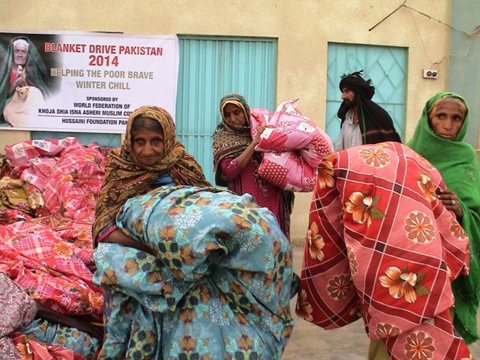
Hadith-e-Kisa Blanket Drive: The World Federation Distributes 1,830 blankets – Punjab, Pakistan
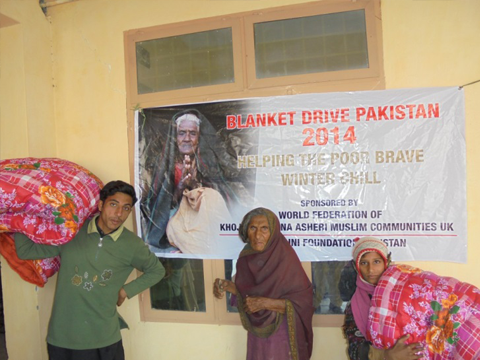
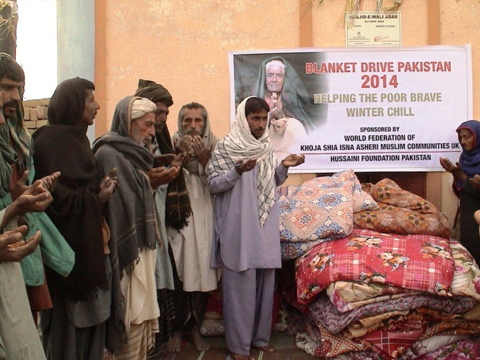
Winters in Pakistan are extremely cold and dry, lasting from December through to February. In December 2014, The World Federation through its Hadith-e-Kisa Blanket Drive distributed 1,830 ‘Razai’ blankets in the districts of Dera Ghazi Khan and Muzaffargarh in Pakistan’s Punjab province. In 2013, these areas were affected by floods and remain underdeveloped.
A ‘Razai’ is a traditional blanket usually used in Afghanistan, Iran, Pakistan, North India and Nepal which is similar to a duvet or a comforter. Razais usually have a cotton, silk or velvet cover which is then stuffed with cotton wool. Air trapped in the cotton wool has an insulating effect and the razai therefore provides a lot of warmth in very cold regions.
The cost of each blanket was $11 USD which was purchased locally. During the distribution, Hadith-e-Kisa was recited by our volunteers and the beneficiaries to remember the warmth and love of the Ahlul Bayt (as).
The World Federation takes this opportunity to thank the donor who sponsored the 2014 Hadith-E-Kisa Blanket Drive in Pakistan with a generous contribution of $20,000 USD.
HADITH-E-KISA BLANKET DRIVE
The ‘Hadith-E-Kisa Blanket Drive’ is a year-round initiative that provides warm blankets and fuel supplies to those affected by the freezing temperatures of the areas in which they live in. These individuals and families usually cannot afford to purchase blankets or fuel to keep them warm in the winter months. Your donation will go a long way in helping families stay warm.
DONATE ONLINE:
In Europe, click here
Rest of the World, click here
JAMAAT TREASURER
Donate directly to your Jamaat Treasurer
For more information, please email [email protected]
 |
 |
Related News

The International Development’s Relief division is the humanitarian arm of The World Federation of KSIMC where we aim to provide practical solutions for the different challenges faced by men, women and children around the world who lack basic provisions in regions of deprivation, war and natural disasters.
The World Federation is excited to introduce the new brand for our International Development work – WF AID.

